Convergent thinkers need to know this
Someone in the meeting suggests the first idea. It sounds fine, and you think: great, done, next item.
If that's you, you probably tend towards convergent thinking. That's a real strength. But there's a misconception about it that many people believe, and a habit that can quietly be costing you results.
That matters, because your greatest professional asset isn't what you know. It's how you think. And how you think is something you can train.
In this article, you'll get
-
a common misconception about convergent thinking and why it isn't true
-
a bad habit of convergent thinkers to watch out for (something your colleagues probably want you to know!)
-
one thing to try this week.
👉 Take our quick convergent or divergent thinking quiz.
First, what is convergent thinking?
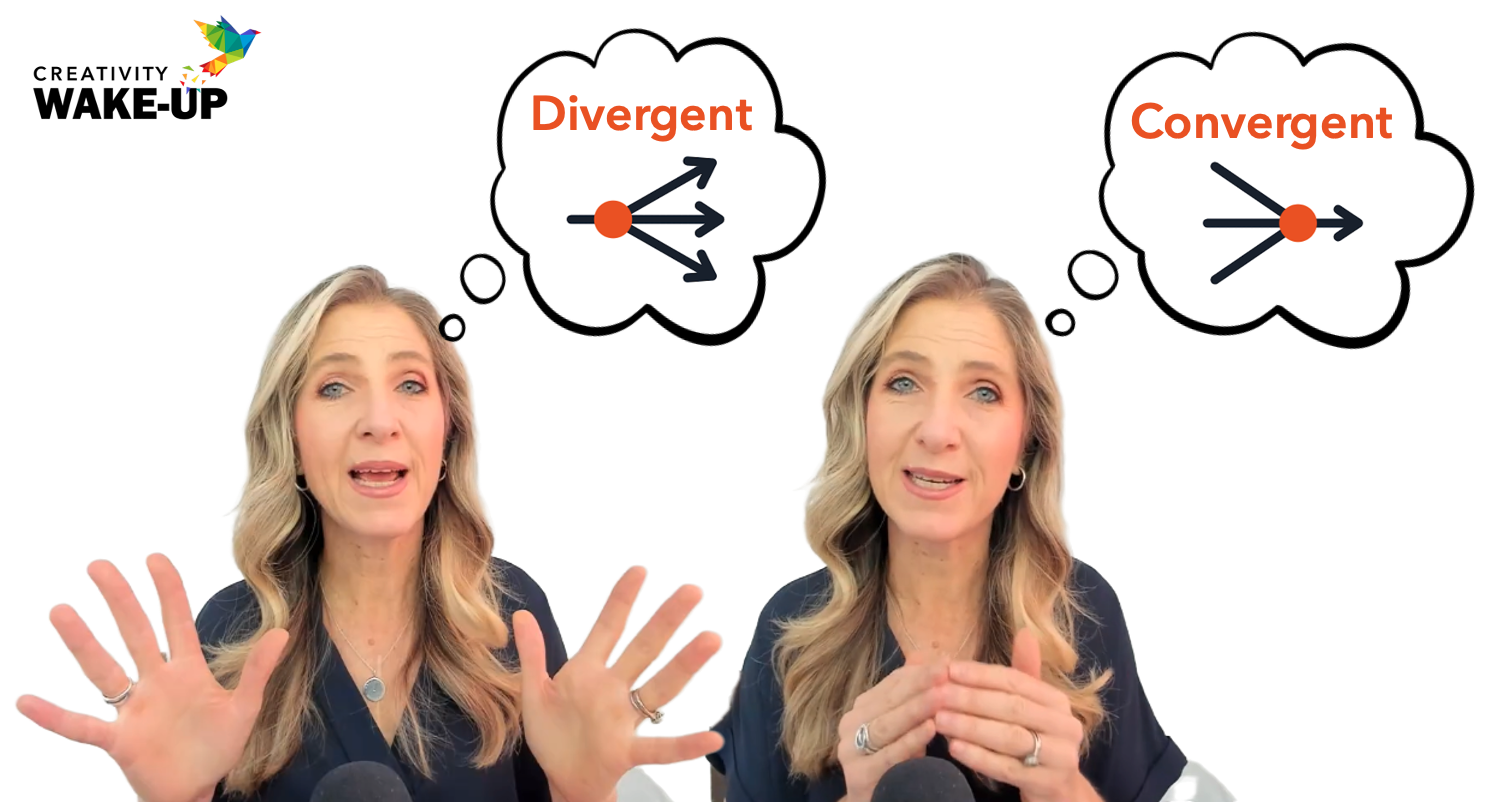
Our brains have two important ways of thinking. Divergent thinking is when we open up: we explore possibilities, make connections and generate different ideas. Convergent thinking is when we narrow down: we explore how those ideas could work, evaluate the options and make decisions.
One helps us expand what's possible. The other turns possibilities into something useful. Good thinking knows when to diverge and when to converge.
A definition worth keeping: convergent thinking is the goal-directed mental process of applying logic, rules and facts to arrive at a clear and appropriate solution.
What’s for dinner?
Friends are coming round for dinner. What are you going to cook? Divergent thinking gives you the possibilities: sushi, burgers, a curry, a braai.
Then convergent thinking takes over. Who's coming? Does anyone have a fish allergy? Are there vegetarians? Maybe you want to make it social and let everyone build their own pizza. You set criteria, evaluate your options, eliminate what won't work and choose the best fit. Then you buy the ingredients and get cooking.
Without convergent thinking, nobody gets any dinner.

The misconception: divergent is the creative one
The common belief is that divergent thinking is creative and convergent thinking is not.
It may go back to the 1950s, when psychologist J.P. Guilford helped change how we understand intelligence and creativity. He challenged the idea that intelligence was simply about finding the one correct answer, which is largely what our schools were built on. His research identified different mental abilities, including divergent and convergent thinking, and helped establish that generating original ideas is an important intellectual ability, one that traditional intelligence tests had overlooked.
Somewhere along the way, many of us took from this that divergent thinking is the creative one. But generating ideas is not the same as creativity. Creative thinking also requires us to evaluate, develop and refine ideas into something both novel and useful.
We need the convergent as much as the divergent. They work together. Without good convergence, you get trapped in brainstorming mode and never actually make a decision or finish the task.

The habit to watch: closing too early
If you tend towards convergent thinking, the stumbling block is closing too quickly. You may decide before enough possibilities have been explored.
Picture this. Your team meets to plan the year-end function. Two minutes in, someone says, "Same place as last year?" Everyone nods. Relief. Done.
And it's fine. It's perfectly fine. But nobody remembers it, because nobody stopped to ask: what else could we do?
That's closing too early. It doesn't mean you have to reinvent the wheel every time. But the first answer that works isn't always the best one. It's just the first one.
And it's not just parties. Perhaps you need someone on your team urgently. The first decent CV lands, you interview them, they're fine, so you hire them, because you're tired and fine feels like enough. Six months later, the hire isn't ideal, it has cost you more money, and you're wondering what else was out there.

Notice the relief
Closing too early happens when we want certainty, or when the pressure's on. It's that lovely feeling of: this is sorted.
But that feeling is your signal. This week, just notice it. When you feel that relief, pause and ask yourself one question:
Is this the best answer, or just the first one?
One thing to try: push for different options
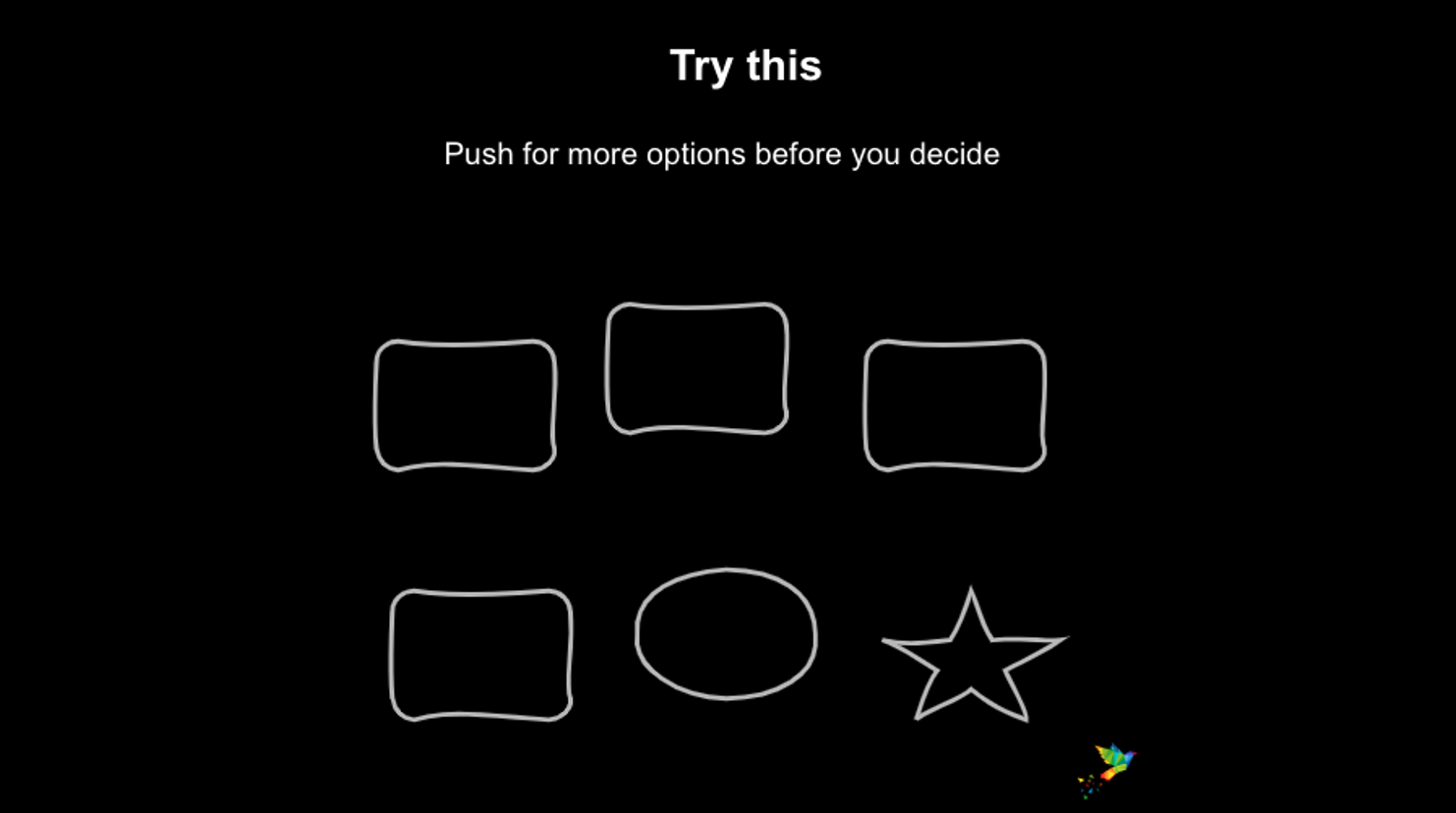
Push for more options before you decide. And not just more options: different options.
Here's what usually happens. We come up with a few options, but they're basically the same idea in different outfits. What you really want are options that differ in approach, in scale or in logic.
If there's only one option, you're not deciding. You're agreeing.
We often see this in teams that have worked together for a long time, or that have settled into entrenched ways of working. Everyone starts thinking the same way and stops challenging each other. That's groupthink
Three questions to get to different options
-
Leave out the obvious. Ask: what's the obvious answer? Your competitors are probably thinking exactly the same thing. Put it aside and find three others.
-
Stand in someone else's shoes. How would a teacher solve this? A doctor? A spaza shop owner? Someone in a different business unit, a different country, or someone from the future? Changing who you imagine changes the logic, not just the wording.
-
Change the trade-offs. Think of a cheap option, a bold option, an option that takes no extra time, an option you could finish by the end of the day. That's how real decisions get made anyway.
Let AI help you find the circle and the star
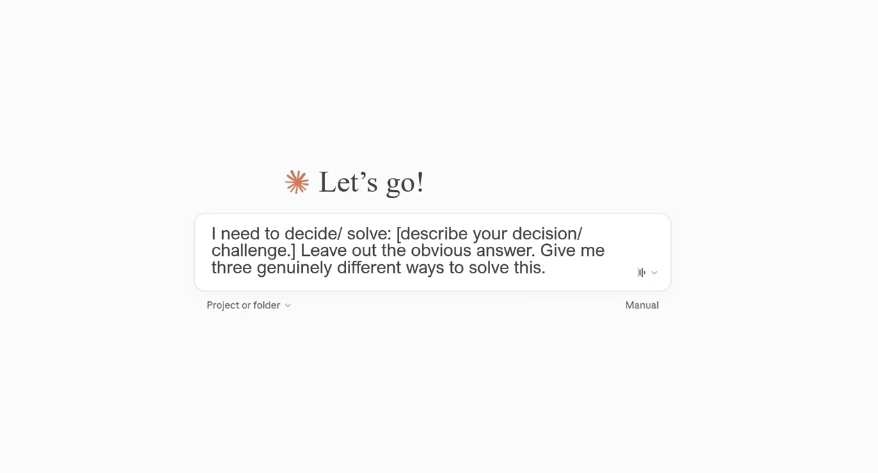
AI tools are good at this, if you ask them. Try something like:
I need to decide or solve [your challenge]. The obvious answer is [state it], so leave it out. Give me three different ways to solve this: a bold option, one we could do in a short space of time, and one that someone in my industry would never have considered. For each option, give me one strength and one risk.
Used this way, AI becomes a counterbalance to your natural way of thinking, rather than more of the same.
Open up first, then close down
Being creative, and getting great results from your thinking, isn't about choosing between opening up and closing down. We need both, just not at the same time.
Open your arms up wide: that's divergent thinking. Now curl into a small ball: that's convergent thinking. You can't do both at once. Give yourself time to diverge first, then converge.
If you lead a team, your job is to help them know which one the moment needs.
Your turn
Not sure which way your thinking leans? Take our quick convergent or divergent thinking quiz.
And if you tend to converge, there's probably someone at work who drives you a little mad with all their ideas. Send them the quiz and compare results over coffee. I guarantee it will be an interesting conversation.
Watch the full video: https://tinyurl.com/convergent-video
Nina Pearse, Creativity Wake-Up

Nina Pearse
Author
Nina Pearse is a dynamic and creative facilitator with a vision to transform business and society by helping people tap into their creativity. Nina has an honours degree in business science from the University of Cape Town. She is an adjunct faculty member at the Gordon Institute of Business Science.
Recent Posts
